The Workplace Massage Debate Nobody Talks About Honestly
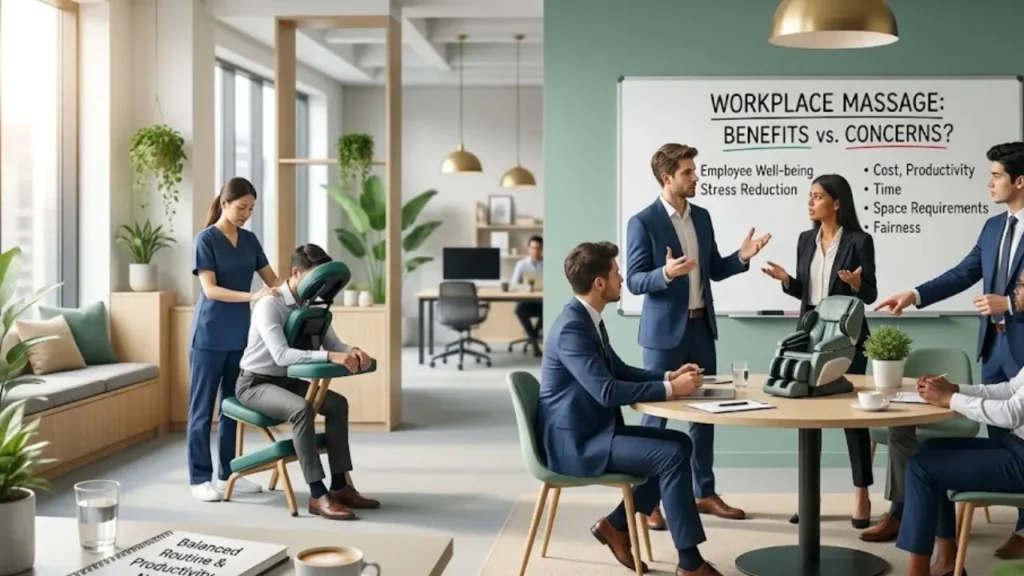
The Workplace Massage Debate Nobody Talks About Honestly Let me tell you about the conversation I had with two different people in the same week. First person worked at a tech company in London. Their HR team had just brought in chair massage every other Friday. 15 minutes per person, right there in the office, fully clothed, straight back to your desk after. She loved it. Said it was the best thing her company had ever done for staff. Second person worked at a smaller creative agency. Their company tried the same thing once and people barely signed up. The therapist sat there with an empty schedule for 2 hours. The program got cancelled after one month. Same idea. Completely different results. The difference wasn’t the massage itself. It was the setup, the communication, and whether the right type of massage was chosen for that specific workplace. That’s exactly what this article is about. Chair massage vs traditional massage, what actually works in a workplace, and how to figure out which one fits your office without wasting money or making your employees feel awkward. I’ve experienced both. I’ve talked to people who’ve had both in their workplaces. And the answer isn’t as simple as “one is better than the other.” It depends on things most companies don’t think about before booking their first session. Let’s break it all down properly. What Is Chair Massage and Why Do Offices Love It? Chair massage is exactly what the name says. You sit in a specially designed chair, lean forward into a padded headrest, and a licensed therapist works on your neck, shoulders, upper back, and arms. You stay fully clothed the entire time. No oils. No undressing. No lying down on a table in a dimly lit room. The chair itself is portable. It folds up into a bag about the size of a large suitcase and sets up in roughly 3 to 5 minutes anywhere there’s a bit of floor space. A quiet corner of the break room. A spare office. Even a section of a larger open plan office with some privacy screens around it. Sessions are short by design. Most workplace chair massage slots run between 10 and 20 minutes. Some companies do 30 minute sessions for employees with more serious tension issues, but 15 minutes is the sweet spot for most office programs. I had my first chair massage at a company away day about 7 years ago. I remember sitting down thinking “this can’t possibly do much in 15 minutes.” I walked away feeling like someone had physically removed a brick from between my shoulder blades. My neck moved freely for the first time in weeks. That’s the thing about chair massage. It’s fast but it’s focused. The therapist isn’t trying to relax your entire body. They’re targeting the exact spots that desk work destroys, your neck, your upper back, your shoulders, and your forearms. Those are the exact places that take the most punishment from 8 hours of typing, clicking, and staring at a screen. Chair massage works so well in offices for a few very practical reasons. It needs zero prep from the employee. You don’t need to book it days in advance, change your clothes, shower before or after, or block out a huge chunk of your afternoon. You sign up for a 15 minute slot, you sit down, you get worked on, you go back to your desk. The whole thing fits inside a normal working day without disrupting anything. It’s also completely non-intimidating. Some people feel uncomfortable with the idea of traditional massage because of the undressing involved. Chair massage removes that barrier completely. You’re fully clothed, you’re sitting upright, and the whole experience feels more like a professional service than a personal one. On-site chair massage is genuinely one of the easiest employee wellness wins available to any company right now. Low cost, low disruption, high impact. That combination is rare. What Is Traditional Massage and What Does It Actually Involve? Traditional massage is what most people picture when someone says the word massage. You go into a private room. You undress to your comfort level, usually down to your underwear, and lie down on a padded table covered with a sheet. The therapist uses oils or lotions and works on your muscles using their hands, forearms, and sometimes elbows. You’re covered by the sheet throughout and only the area being worked on gets uncovered at any one time. Sessions run much longer than chair massage. A standard traditional massage session runs 60 minutes. Some go 90 minutes. Shorter 30 minute versions exist but they’re less common and still much longer than your average office chair massage slot. The coverage is much broader too. Traditional massage works on your full back, legs, arms, neck, and sometimes your face and scalp depending on the type. Swedish massage, which is the most common style, uses long flowing strokes to relax muscles and improve circulation throughout the whole body. Deep tissue massage goes harder, targeting deeper muscle layers to work out chronic tension and knots that have built up over months or years. There are also more specialized forms. Hot stone massage uses heated stones placed on specific points across your back. Sports massage focuses on muscle recovery and injury prevention. Aromatherapy massage adds essential oils for relaxation or invigoration depending on what you need. Traditional massage done well is a genuinely powerful experience. I had a deep tissue session after a particularly brutal stretch of 60 hour weeks and I walked out feeling like a completely different person. Not just relaxed. Actually reset. The challenge with traditional massage in a workplace context is obvious. You need a private room. You need enough time in the schedule. You need employees comfortable enough to undress at work. And sessions cost significantly more than a quick 15 minute chair slot. These aren’t dealbreakers. Plenty of companies make it work. But they’re real considerations that separate
What Is Mental Health Support in the Workplace?

When you woke up this morning and thought about going to work, how did that feel? Did it feel okay? Or did something in your chest get a little tight? Because for a lot of people, that tight feeling is just Tuesday. Just another normal day of dreading something they can’t quite name. Mental health support in the workplace is basically everything a company does to make sure its employees are doing okay, not just physically, but mentally and emotionally too. It’s not just putting up a poster that says “it’s okay to not be okay” and calling it done. Real workplace mental health support means actual things. Things like access to a counsellor or therapist through work. A manager who checks in on you like a human being instead of just asking about your deadlines. Enough flexibility in your schedule that you don’t feel like you’re constantly drowning. I worked at a place once where the answer to everything was “just push through it.” Stressed about a project? Push through. Feeling burned out after 6 straight months of overtime? Push through. Crying in the bathroom during your lunch break? Probably just push through that too. Nobody talked about mental health. Not once. Not in any meeting, not in any email, not in any company wide announcement. It simply didn’t exist as a topic. And people left. Good people. Smart people who were genuinely great at their jobs. They left because they couldn’t push through anymore. Mental health support at work means not making people choose between their job and their sanity. It covers a wide range of things. An employee assistance program that gives workers free access to therapy sessions. Mental health days built into the leave policy. Training for managers so they can actually spot when someone on their team is struggling. A culture where saying “I’m not doing great” doesn’t automatically end your career prospects. Some companies do this really well. Others think a fruit bowl in the kitchen counts. It doesn’t. The gap between those two approaches is enormous. And the employees living inside that gap feel it every single day. Why Mental Health Matters at Work? Here’s a number that should make every manager and business owner stop scrolling. According to the World Health Organization, depression and anxiety cost the global economy around 1 trillion dollars every single year in lost productivity. Not billions. Trillions. And that’s just the stuff we can measure. That doesn’t count the meetings where someone was physically present but mentally somewhere completely else. It doesn’t count the decisions made badly because someone was running on 4 hours of sleep and 3 weeks of unprocessed stress. It doesn’t count the good ideas that never got shared because someone didn’t feel safe enough to speak up. Work and mental health are not separate things. They bleed into each other constantly. When someone’s mental health is suffering, work suffers with it. They miss more days. They make more mistakes. They talk to customers with less patience. They snap at teammates over small things. They stop caring about quality because they’re spending all their energy just surviving the day. And when work is bad, mental health suffers right back. A toxic manager, an impossible workload, a culture of constant criticism, these things don’t stay at the office. They come home with you. They sit at your dinner table. They wake you up at 3 AM. I went through a period where I was waking up every single night at 3 AM thinking about work. Not a specific problem. Just this general anxiety that sat in my chest like a stone. Nothing was wrong that I could point to. Everything was just slightly too much, all the time. That’s what unmanaged workplace stress actually looks like from the inside. It’s not dramatic. It’s just this slow, grinding, constant weight. Mental health awareness at work matters because people spend roughly a third of their entire lives at work. If that third is making someone feel worthless, anxious, or completely empty, it poisons the other two thirds as well. The good news is that companies that take this seriously see real results. Lower staff turnover. Fewer sick days. Better teamwork. People who actually want to show up instead of people who are just counting down to Friday. Mental wellbeing at work isn’t a soft topic or a nice to have. It’s the foundation that everything else gets built on top of. Common Workplace Mental Health Challenges Nobody talks about this stuff openly enough. So let me just say it plainly. Most workplaces are quietly full of people who are not okay. Not dramatically not okay. Not crying at their desk every day. Just quietly carrying something heavy that never fully goes away. Here are the most common mental health challenges showing up in offices, warehouses, shops, and remote setups right now. Employee burnout is probably the biggest one. Burnout isn’t just being tired. It’s a specific kind of exhaustion where you stop caring. You used to care about doing good work. Now you just want the day to end. You feel detached from everything. Small tasks feel impossible. Big tasks feel pointless. That’s burnout, and it’s everywhere right now. Work related anxiety shows up in a hundred small ways. The constant checking of emails. The inability to switch off after 6 PM. The heart rate spike when your manager calls you unexpectedly. The 20 minutes you spend rewriting a two sentence message because you’re terrified of saying the wrong thing. Depression in the workplace is more common than most companies want to admit. People dealing with depression don’t always look sad. Sometimes they look fine. They show up. They do the work. But inside they feel completely hollow and disconnected from everything around them. Mental health stigma is still a massive problem in most workplaces. People don’t speak up about struggling because they’re afraid of being seen as weak, difficult, or not committed enough. So they


