

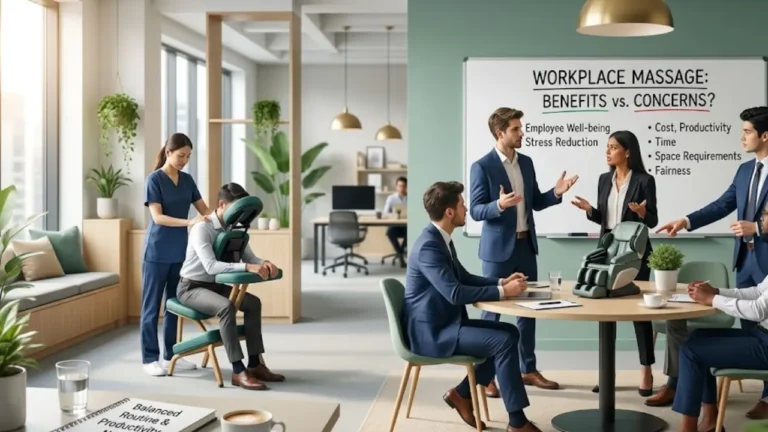
The Workplace Massage Debate Nobody Talks About Honestly
Let me tell you about the conversation I had with two different people in the same week.
First person worked at a tech company in London. Their HR team had just brought in chair massage every other Friday. 15 minutes per person, right there in the office, fully clothed, straight back to your desk after. She loved it. Said it was the best thing her company had ever done for staff.
Second person worked at a smaller creative agency. Their company tried the same thing once and people barely signed up. The therapist sat there with an empty schedule for 2 hours. The program got cancelled after one month.
Same idea. Completely different results.
The difference wasn’t the massage itself. It was the setup, the communication, and whether the right type of massage was chosen for that specific workplace.
That’s exactly what this article is about. Chair massage vs traditional massage, what actually works in a workplace, and how to figure out which one fits your office without wasting money or making your employees feel awkward.
I’ve experienced both. I’ve talked to people who’ve had both in their workplaces. And the answer isn’t as simple as “one is better than the other.” It depends on things most companies don’t think about before booking their first session.
Let’s break it all down properly.
What Is Chair Massage and Why Do Offices Love It?
Chair massage is exactly what the name says. You sit in a specially designed chair, lean forward into a padded headrest, and a licensed therapist works on your neck, shoulders, upper back, and arms. You stay fully clothed the entire time. No oils. No undressing. No lying down on a table in a dimly lit room.
The chair itself is portable. It folds up into a bag about the size of a large suitcase and sets up in roughly 3 to 5 minutes anywhere there’s a bit of floor space. A quiet corner of the break room. A spare office. Even a section of a larger open plan office with some privacy screens around it.
Sessions are short by design. Most workplace chair massage slots run between 10 and 20 minutes. Some companies do 30 minute sessions for employees with more serious tension issues, but 15 minutes is the sweet spot for most office programs.
I had my first chair massage at a company away day about 7 years ago. I remember sitting down thinking “this can’t possibly do much in 15 minutes.” I walked away feeling like someone had physically removed a brick from between my shoulder blades. My neck moved freely for the first time in weeks.
That’s the thing about chair massage. It’s fast but it’s focused. The therapist isn’t trying to relax your entire body. They’re targeting the exact spots that desk work destroys, your neck, your upper back, your shoulders, and your forearms. Those are the exact places that take the most punishment from 8 hours of typing, clicking, and staring at a screen.
Chair massage works so well in offices for a few very practical reasons.
It needs zero prep from the employee. You don’t need to book it days in advance, change your clothes, shower before or after, or block out a huge chunk of your afternoon. You sign up for a 15 minute slot, you sit down, you get worked on, you go back to your desk. The whole thing fits inside a normal working day without disrupting anything.
It’s also completely non-intimidating. Some people feel uncomfortable with the idea of traditional massage because of the undressing involved. Chair massage removes that barrier completely. You’re fully clothed, you’re sitting upright, and the whole experience feels more like a professional service than a personal one.
On-site chair massage is genuinely one of the easiest employee wellness wins available to any company right now. Low cost, low disruption, high impact. That combination is rare.
What Is Traditional Massage and What Does It Actually Involve?
Traditional massage is what most people picture when someone says the word massage.
You go into a private room. You undress to your comfort level, usually down to your underwear, and lie down on a padded table covered with a sheet. The therapist uses oils or lotions and works on your muscles using their hands, forearms, and sometimes elbows. You’re covered by the sheet throughout and only the area being worked on gets uncovered at any one time.
Sessions run much longer than chair massage. A standard traditional massage session runs 60 minutes. Some go 90 minutes. Shorter 30 minute versions exist but they’re less common and still much longer than your average office chair massage slot.
The coverage is much broader too. Traditional massage works on your full back, legs, arms, neck, and sometimes your face and scalp depending on the type. Swedish massage, which is the most common style, uses long flowing strokes to relax muscles and improve circulation throughout the whole body. Deep tissue massage goes harder, targeting deeper muscle layers to work out chronic tension and knots that have built up over months or years.
There are also more specialized forms. Hot stone massage uses heated stones placed on specific points across your back. Sports massage focuses on muscle recovery and injury prevention. Aromatherapy massage adds essential oils for relaxation or invigoration depending on what you need.
Traditional massage done well is a genuinely powerful experience. I had a deep tissue session after a particularly brutal stretch of 60 hour weeks and I walked out feeling like a completely different person. Not just relaxed. Actually reset.
The challenge with traditional massage in a workplace context is obvious. You need a private room. You need enough time in the schedule. You need employees comfortable enough to undress at work. And sessions cost significantly more than a quick 15 minute chair slot.
These aren’t dealbreakers. Plenty of companies make it work. But they’re real considerations that separate chair massage vs traditional massage as workplace options.
Chair Massage vs Traditional Massage: The Real Differences Nobody Lists
Most articles comparing these two just give you a basic table. Chair massage is shorter. Traditional massage is longer. Chair massage keeps your clothes on. Traditional massage uses oils.
You already know that. Let me tell you the stuff that actually matters when you’re deciding which one works for your workplace.
The comfort barrier is massive. Chair massage has almost zero barrier to entry. Anyone can sit in a chair for 15 minutes during their lunch break. Traditional massage asks people to undress at their workplace, which for a lot of employees feels genuinely uncomfortable. Even if the room is private and professional, the idea of lying under a sheet two doors down from their manager is a hard sell for many people. Lower barrier means higher participation rates, and participation rates determine whether your wellness program actually works or just looks good on paper.
The depth of relief is genuinely different. Chair massage targets specific areas really well, especially neck, shoulders, and upper back. But it can’t reach everything. Deep tension in your lower back, your hamstrings, your hips from sitting all day, that stuff needs table work to address properly. If your employees are dealing with chronic pain rather than just everyday tension, chair massage alone won’t fully solve it.
Time disruption affects different teams differently. A 15 minute chair massage barely interrupts anyone’s day. A 60 minute traditional massage session takes a significant chunk out of the working day. For teams with packed schedules and back to back meetings, that hour is genuinely hard to give up. For teams with more flexible schedules or remote workers coming into the office specifically for a wellness day, it’s much more manageable.
The recovery factor is real. After a deep traditional massage, especially deep tissue, some people feel slightly drowsy or physically heavy for an hour or two. That’s a normal physiological response. But it’s not ideal if someone needs to jump straight into a client presentation after their session. Chair massage doesn’t produce that effect. You feel lighter and looser but completely alert and ready to work.
Cost per person is dramatically different. A 15 minute chair massage slot costs a company roughly 15 to 30 dollars per employee. A 60 minute traditional massage costs somewhere between 60 and 100 dollars per person. If you’re running a program for 30 employees, that difference adds up to thousands of dollars per session.
Frequency changes what each type achieves. Chair massage works brilliantly as a regular ongoing program, weekly or biweekly, because it maintains baseline tension levels across your whole team continuously. Traditional massage works better as an occasional deeper reset, maybe once a quarter for employees who want something more thorough.
The honest answer is that these two types aren’t really competing. They solve slightly different problems at different price points and time commitments.
Why Chair Massage Wins on Pure Workplace Practicality
When you strip away everything else and just look at what actually works in a real office environment, chair massage wins on practicality almost every time.
Here’s why from someone who’s watched both get implemented.
Setup takes under 5 minutes. A skilled therapist with a portable chair can be ready to go in any available space almost immediately. No room preparation, no special lighting, no oil warmers, no table linens. You point to a corner, they set up, and the first employee sits down within minutes.
More employees get covered in the same time. In a single hour, a chair massage therapist can get through 4 to 6 employees comfortably with 10 to 15 minute sessions each. A traditional massage therapist can serve 1 employee per hour. If you’ve got a team of 20 people and want everyone to benefit on the same day, you need either 20 hours of traditional massage time or about 4 to 5 hours of chair massage time. The math makes the decision pretty easy.
Employee uptake is consistently higher. Companies that switch from occasional traditional massage events to regular on-site chair massage almost always report more employees actually using the program. The shorter time commitment, the fully clothed format, and the convenience of not leaving the building all remove friction that stops people from participating.
It works for all body types and mobility levels. Traditional massage tables can sometimes be uncomfortable or inaccessible for employees with certain physical conditions or mobility challenges. A well designed massage chair adjusts easily and works comfortably for almost everyone.
It fits into any office. Not every workplace has a spare private room available. Open plan offices, shared coworking spaces, retail back rooms, warehouse break areas. Chair massage works in all of them with just a small privacy screen if needed. Traditional massage needs a dedicated private space that many workplaces simply don’t have.
The benefits are immediate and obvious. Employees walk away from a 15 minute seated massage session noticeably less tense. The change is visible. Other employees see it, get curious, and sign up next time. This word of mouth effect builds program momentum naturally without any extra effort from HR.
Corporate massage programs built around chair massage consistently show better long term participation than those built around less frequent traditional massage events. And in workplace wellness, consistency beats intensity every single time.
What Traditional Massage Does That a Chair Simply Can’t
Okay so I’ve been pretty positive about chair massage up to this point. And it deserves that. But let me be completely straight with you about where traditional massage genuinely wins.
Because it does win. In specific situations. For specific people. And pretending otherwise would be dishonest.
My cousin works a physical job. Not an office. He’s on his feet 10 hours a day, lifting, moving, bending. His whole body takes damage daily, not just his neck and shoulders. When his company offered chair massage as their wellness solution, he appreciated it but it barely touched his actual problems. His lower back, his hamstrings, his calves, none of that got addressed.
He started getting monthly traditional massage sessions privately and the difference was night and day. Not just surface relaxation. Deep, actual muscle repair that let him keep doing his job without breaking down physically.
That’s the first place traditional massage wins clearly. Full body coverage. Chair massage is brilliant at the top half. Everything from your waist down gets completely ignored. If your employees stand all day, drive long distances for work, or do any physical labour, their legs and lower back need attention that only a table session can properly provide.
Chronic pain needs deeper work. There’s a difference between everyday tension and actual chronic muscle problems. Knots that have been building for months or years sit deep inside muscle tissue. A 15 minute chair session can ease the surface tension around them but it can’t fully break them down. Deep tissue traditional massage goes in properly. It takes longer, it can feel intense during the session, but the relief it produces lasts significantly longer too.
Recovery from injury benefits more from traditional massage. If someone on your team is coming back from a shoulder injury, a repetitive strain issue, or any kind of musculoskeletal problem, proper therapeutic massage on a table gives the therapist access and control they simply don’t have with a chair setup. They can assess the full area, work with the surrounding muscle groups, and adjust pressure precisely throughout.
The full relaxation response is different. Lying down horizontally triggers your body’s rest response in a way that sitting in a chair, even a comfortable massage chair, doesn’t quite replicate. Your nervous system genuinely shifts into a deeper state of calm. For employees dealing with serious burnout or severe stress accumulation, that deeper state of relaxation has real therapeutic value beyond what a quick chair session delivers.
Privacy and disconnection matter for some people. Some employees genuinely need 60 minutes completely away from the office environment to actually decompress. A quiet private room, no sounds of the office outside, no colleagues nearby. That separation is itself part of the therapy.
Traditional massage isn’t impractical. It’s just a different tool for a different level of need.
Picking the Right One Without Overthinking It
Chair massage is your everyday maintenance. Traditional massage is your deep repair.
Think of it like car servicing. You put air in your tyres regularly, check the oil, keep things ticking over. That’s chair massage. Then once or twice a year you take the car in for a full service where everything gets properly checked and fixed. That’s traditional massage.
Both matter. Neither one replaces the other completely.
So how do you actually decide which one to bring into your workplace?
Ask what problem you’re trying to solve first. If your team sits at desks all day and mainly deals with neck pain, shoulder tension, and general stress from screen time, chair massage handles that brilliantly. If your team does physical work, has employees with chronic pain issues, or you want to offer a premium wellness benefit that goes deeper than a quick session, traditional massage makes more sense.
Consider your physical space honestly. Do you have a private room available? Not a room you can occasionally clear out with 3 days notice, but a room that’s reliably available on massage days? If yes, traditional massage becomes more practical. If your office is open plan with limited private space, chair massage is the obvious choice.
Look at your budget per employee. If you can spend 15 to 30 dollars per person regularly, chair massage gives you consistent weekly or biweekly coverage for your whole team. If your budget is more limited and you’re thinking one bigger event per quarter, spending 70 to 100 dollars per person on a proper traditional massage session might actually stretch further in terms of impact.
Think about your team’s comfort level. Some workplaces have open cultures where employees wouldn’t think twice about getting a table massage at work. Others have more reserved cultures where the idea feels awkward. You know your team. Don’t push something that’s going to make people uncomfortable and then wonder why nobody signs up.
The best workplace massage programs I’ve seen don’t choose one or the other. They use chair massage as the regular backbone of their employee wellness program, maybe every 2 weeks, and then do a traditional massage event once a quarter as something special. Employees get consistent maintenance plus occasional deeper relief. That combination covers almost every need across a diverse team.
Start with whichever one fits your space, budget, and team culture right now. You can always add the other one later once you see how people respond.
How Workplace Massage Actually Changes the Way People Work
It wasn’t the massage itself that changed things. It was what happened after.
The Thursday our office had chair massage for the first time, something felt different in the afternoon. Not dramatically different. Just quieter in a good way. People were more patient in meetings. The usual 3 PM grumpiness that normally settled over the open plan office like a grey cloud was just… lighter.
I mentioned it to a colleague and she said “yeah I noticed that too, everyone got their shoulders out of their ears for once.”
That’s exactly it. When your body isn’t clenched and tense, your mind follows. You think more clearly. You react less sharply. You actually hear what people are saying in meetings instead of half listening while mentally rubbing your own neck.
This is how workplace massage supports employee wellness in ways that go way beyond the physical.
Focus improves directly after massage. Research from the Touch Research Institute at the University of Miami found that even a 15 minute chair massage improved speed and accuracy on tasks requiring attention and focus. Not slightly improved. Significantly. Employees completed math problems faster and with fewer errors after a massage session compared to employees who just sat quietly for the same 15 minutes.
Cortisol drops fast. Cortisol is the stress hormone your body pumps out when you’re under pressure. Chronically high cortisol levels affect memory, decision making, immune function, and sleep quality. Massage measurably reduces cortisol levels within a single session. Lower cortisol means clearer thinking, better decisions, and less of that low grade irritability that makes everyone in an office slightly harder to work with.
Team dynamics shift. This one’s harder to measure but easy to observe. Offices that have regular massage programs report better communication between team members. People who feel physically comfortable and emotionally supported interact differently with their colleagues. They share ideas more freely. They’re less defensive in feedback conversations. They collaborate instead of compete.
Sick days reduce over time. Chronic stress weakens your immune system directly. Employees carrying constant tension get sick more often and take longer to recover. Regular massage as part of a wider workplace wellness program helps break that cycle. Companies that track this properly see measurable reductions in sick day usage within 3 to 6 months of starting a consistent program.
Workplace massage isn’t just a nice perk. It’s a genuine productivity and wellness tool that works through the body to fix problems that show up in the work.
Building a Massage Program That People Actually Use
Here’s the honest problem with most workplace massage programs. They start well and quietly die within 4 months.
The therapist shows up the first week and every slot gets booked instantly. The second week is still pretty full. By week six there are empty slots. By month four the whole thing gets quietly cancelled because “not enough people are using it.”
This happens because the program was set up but never properly maintained. Here’s how to build one that actually sticks.
Make the first session unforgettable. The employees who try it on day one become your biggest advocates. If their first experience is genuinely good, they’ll tell three other people about it before the day is over. Choose a therapist who’s excellent, not just available, for your launch session.
Keep the sign up system stupid simple. I’ve seen companies kill their own programs by making sign up complicated. A shared Google sheet works fine. A whiteboard in the kitchen works fine. An email to HR works fine. What doesn’t work is a multi step online booking system that takes 4 minutes to navigate on a phone.
Send a reminder every single time. Don’t assume people remember. Send an email or a Slack message the morning of every massage day. Keep it short. “Massage sessions today from 2 to 5 PM, sign up sheet in the kitchen, 3 slots still available.” That’s it. That reminder alone doubles participation rates.
Protect the program during busy periods. Companies cancel massage days during their most stressful weeks because “everyone’s too busy.” That’s exactly backwards. The weeks when your team is most stressed are the weeks they need it most. Cancelling during crunch periods sends completely the wrong message about how much the company actually values employee wellbeing.
Rotate time slots across different teams. If massage always happens on Thursday afternoons and your customer service team can never leave their phones on Thursday afternoons, they never get to participate. Rotate the day and time occasionally so different teams get fair access over time.
Ask for feedback after the first month. A 3 question anonymous survey. Did you use the massage program? If yes, how did it make you feel? What would make it better? That feedback tells you everything you need to adjust the program before it loses momentum.
The companies with massage programs that last years aren’t doing anything fancy. They’re just being consistent, communicating well, and actually listening to what their employees want from it.
What Nobody Tells You About Workplace Massage Costs (The Real Numbers)
Most articles just throw a price range at you and move on. I want to actually walk you through how the money works in real life because the numbers look very different depending on how you structure things.
Let’s start with chair massage since that’s what most companies begin with.
A qualified mobile massage therapist coming to your office typically charges somewhere between 90 and 150 dollars per hour depending on your city and their experience level. In London or New York that number sits closer to the top. In smaller cities it’s usually closer to the bottom.
In that one hour they can realistically complete 4 sessions at 15 minutes each. So your cost per employee works out to roughly 22 to 37 dollars per person for a 15 minute session.
If you negotiate a half day booking, say 4 hours, you’re covering roughly 16 employees. At 120 dollars per hour that’s 480 dollars total for 16 people. Under 30 dollars per person for a genuine wellness benefit they’ll talk about for days afterward.
Full day bookings get cheaper per hour. Most therapists offer a small discount for 6 to 8 hour bookings, sometimes dropping to 80 or 90 dollars per hour if you commit to a regular schedule.
Now traditional massage costs more because sessions run longer and the setup is more involved. Expect to pay 60 to 100 dollars per employee for a 30 minute table session and 90 to 150 dollars for a full 60 minute session. If you’re bringing therapists in for a quarterly wellness day covering 20 employees with 30 minute sessions each, you’re looking at 1200 to 2000 dollars for that single day.
That sounds like a lot until you compare it to what companies spend on other wellness initiatives that get far less engagement. I’ve seen companies spend 5000 dollars on a wellness app that 8 percent of employees ever opened. The massage program they could have run for an entire year cost less.
The cost per engagement calculation matters more than the total cost. If 18 out of 20 employees use the massage program every session, your cost per engaged employee is genuinely low. If 3 out of 20 employees ever log into your wellness app, that app costs you far more per actual user even if the sticker price looks cheaper.
Some companies reduce their costs further by subsidizing instead of covering everything. Employees pay 10 or 15 dollars per session out of pocket and the company covers the rest. This small personal contribution actually increases commitment and reduces no shows dramatically.
Corporate massage providers who specialize in on-site chair massage sometimes offer package deals. Committing to 12 monthly visits upfront often brings the per visit rate down by 15 to 20 percent compared to booking month by month.
The real cost of not having a program is harder to see but it’s there. One employee taking 3 extra sick days a year due to stress related illness costs more than a full year of biweekly chair massage sessions for that same person.
Honest Answers to the Questions Everyone Actually Searches For
People search some very specific things about this topic and most articles dodge them. I’m not going to do that.
Q: Chair massage vs traditional massage, which is better?
A: Neither one is universally better. Chair massage is better for regular ongoing office wellness programs because it’s practical, fast, affordable, and gets high participation. Traditional massage is better for deeper therapeutic needs, full body tension, chronic pain, and quarterly reset events. The best answer is using both for different purposes.
Q: Is a massage chair the same as getting a real massage?
A: No. A massage chair machine, the ones you sit in at airports or buy for your home, is not the same as a human therapist doing chair massage. A real therapist reads your body, adjusts pressure, finds specific problem areas, and responds to feedback in real time. A machine follows a preset program regardless of what your body actually needs. Human beats machine every time for actual therapeutic benefit.
Q: Why do people regret buying massage chairs for their office?
A: Because they think a machine replaces a therapist and it doesn’t. Companies buy expensive massage chair machines thinking they’ve solved the problem permanently. Employees use them heavily for 3 weeks, then occasionally for a month, then almost never. The novelty wears off fast because the machine never changes, never improves, never finds that specific knot that’s been bothering you since March.
Q: Can chair massage help with serious back pain?
A: It helps with upper back tension really well. For serious lower back problems, you need a proper assessment from a physiotherapist or a full traditional massage session with a qualified therapist who can work the area properly. Chair massage maintains and prevents. It’s not a treatment for existing serious conditions.